Knowledge
Blaise Pascal and the Five-Sol Coaches of Paris, 1662
In the spring of 1662, horse-drawn coaches began running on fixed routes through Paris, departing at set times for a fixed fare of five sols per seat. Blaise Pascal was one of the people behind them. The system is often counted as an early example of organised public transport in a city.
Published
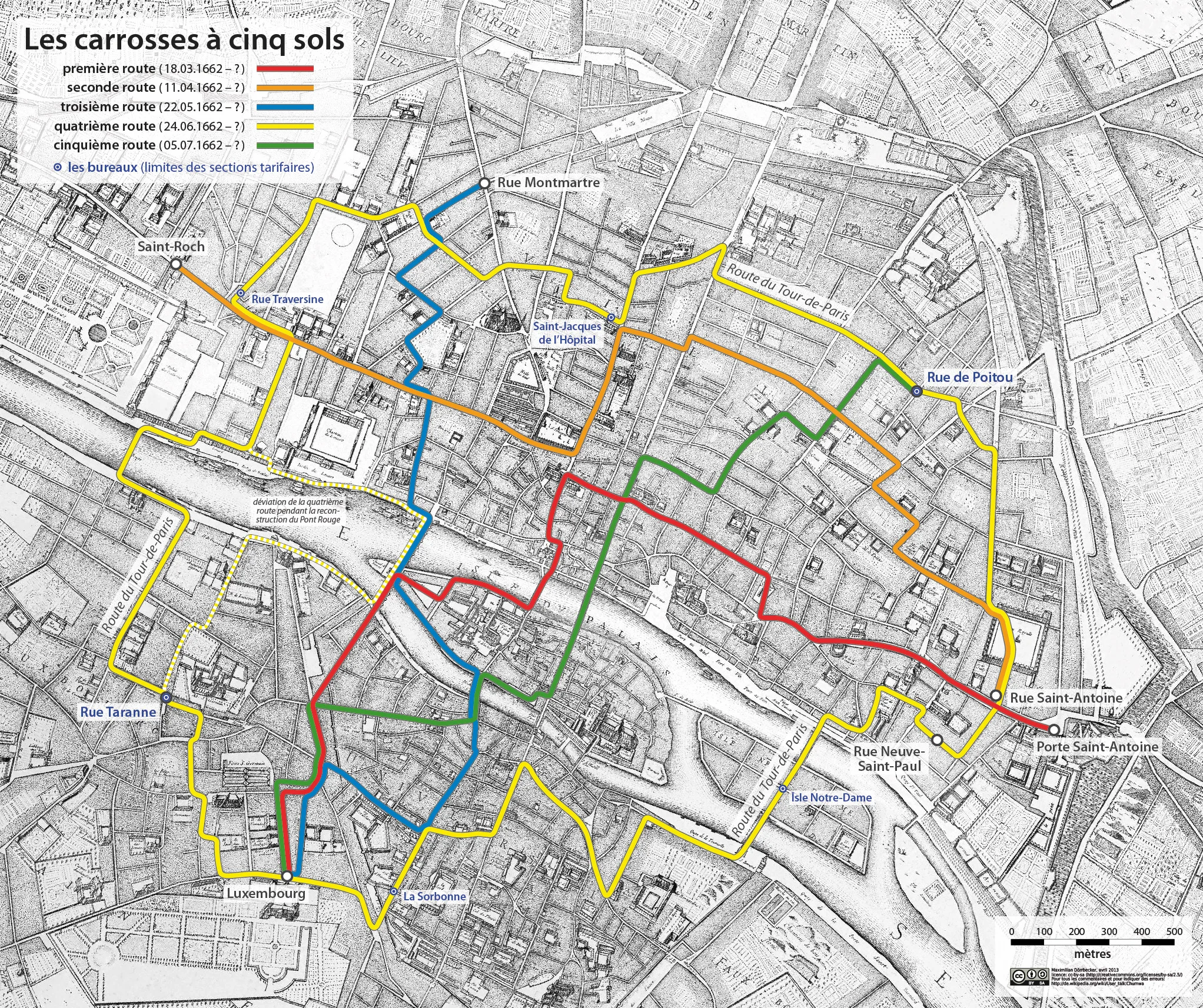 Open the map in a larger size

Five full coaches
On 21 March 1662, three days after the first route opened, Pascal’s sister Gilberte Périer wrote to Arnauld de Pomponne, one of the investors, about the success. She had been waiting at the Saint-Merry gate on rue de la Verrerie, hoping to ride back to her brother’s home. Five coaches passed by, all of them full. Around her people praised the scheme – and complained that seven coaches on a route were far too few; there ought to be at least twenty.[2]
On the opening day, Saturday 18 March, the coaches had been sent off under guard, with officials from the Châtelet present and the king’s order that anyone causing trouble would be severely punished. According to the letter, craftsmen along the route stopped work to watch, as if it were a holiday.[2]
Pascal and his partners
The privilege – the exclusive right to run the coaches – was granted by Louis XIV in January 1662 to the Duke of Roannez and the marquises of Sourches and Crenan, and registered by the Parlement of Paris on 27 February.[2] Pascal, a friend of Roannez, and his sister had a stake in the venture; Gilberte reported the news because Pascal, by then seriously ill, no longer wrote letters himself. He added a short postscript of his own.[2]
How large Pascal’s part was is not clear. The BnF presents the company as founded by Pascal,[1] and the 17th-century writer Henri Sauval called him its inventor. Monmerqué, who published the documents in 1828, thought it unlikely that Pascal had come up with the idea and more likely that he had invested in his friend’s enterprise.[2] Gilberte later told how Pascal wanted an advance of a thousand francs on his share to send to the poor of Blois.[2]
A journey for five sols
The letters patent describe the coaches as being for people of modest means – such as people with business at the courts and the infirm – who could not afford a sedan chair or a hired carriage, which cost a pistole or two écus a day. The price was five sols marqués per seat, and each passenger paid only for their own place.[2]
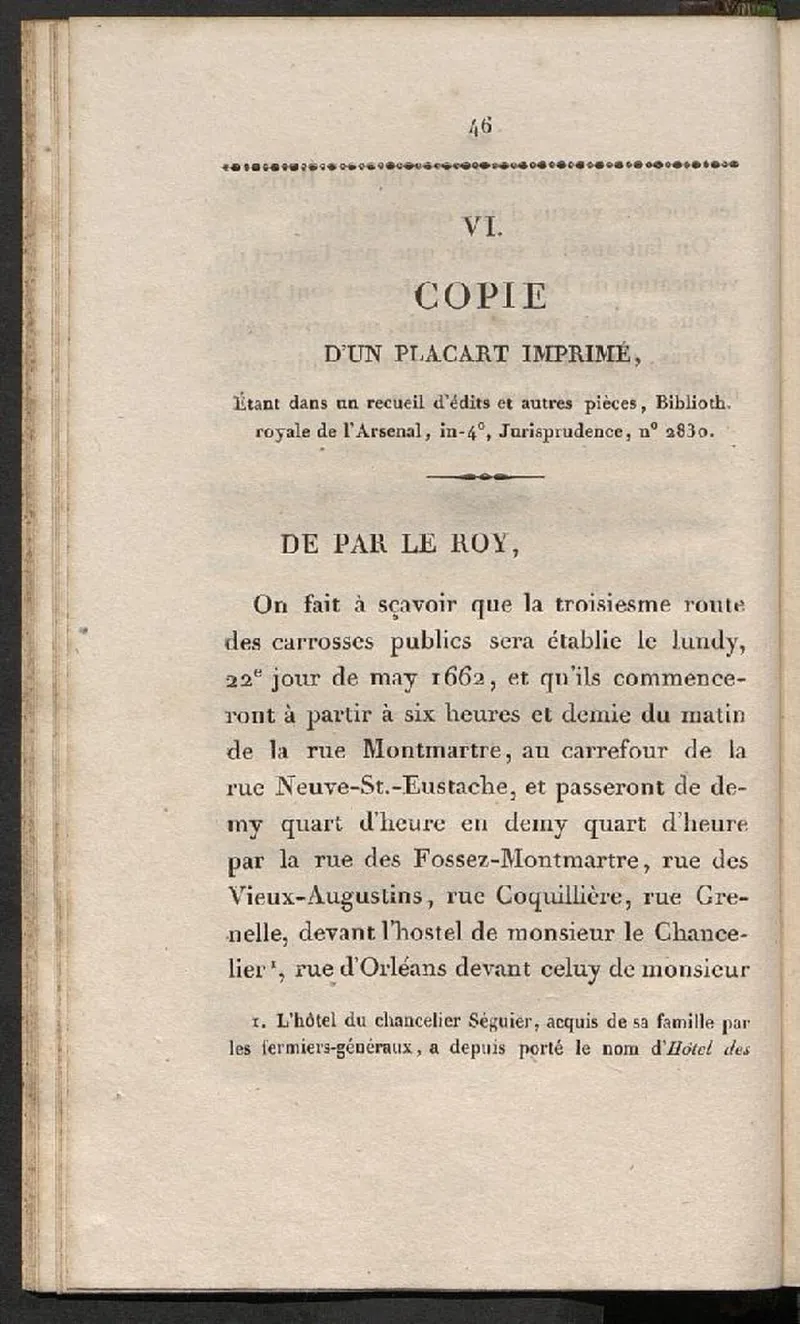
The notice for the third route adds practical rules: anyone who changed coaches paid again, no gold coins were accepted, to avoid slow changing of money, and each coach now took eight people “at ease”.[3] According to Sauval the price was later raised by one sol.[2]
Routes and departures
The coaches ran on fixed routes and left at set times – even empty if nobody turned up.[2] The first route, opened on 18 March 1662 with seven coaches, ran between Porte Saint-Antoine and the Luxembourg. The second, from rue Saint-Antoine opposite the Place Royale to Saint-Roch, opened on 11 April, and the third, from rue Montmartre to the Luxembourg, on 22 May.[2]
According to the notice, the third route started at half past six in the morning, and the coaches passed every half quarter of an hour, that is every seven and a half minutes. They stopped wherever passengers wanted to get on or off along the route. At the Croix du Tiroir passengers could change to the second route.[3] The coaches bore the city’s arms, the coachmen and footmen wore blue coats, and every coach was numbered so that complaints could be made at the offices at either end of the route.[3]
The sources differ on the size of the network. The BnF describes five routes with set stops.[1] Monmerqué’s documents cover the first three, and he points out that a comedy from 1662 mentions only those.[2] The modern map at the top shows five routes, the last two opening in June and July 1662.
Who could ride?
Not everyone. When the Parlement verified the privilege, it banned soldiers, pages, lackeys and other liveried servants, as well as labourers and manual workers, from the coaches – “for the greater convenience and freedom of the bourgeois”, as the notice put it.[3]
Gilberte noted that several women rode on the very first morning.[2] Sauval writes that officials from the courts used the coaches without hesitation, that the Duke of Enghien rode in one, and that the king himself once took one at Saint-Germain.[2]
What happened next
Pascal died on 19 August 1662, five months after the first route opened.[2] What happened to the coaches after that is uncertain. Sauval writes that three or four years after they started they were hardly used any more, and blamed the decline on Pascal’s death.[2] The BnF, on the other hand, states that the service ran successfully until 1679.[1] The sources thus give different answers, and exactly when the traffic ended is not known.
Paris would not get public transport on a large scale again until the 19th century, with the omnibus.[1] Monmerqué published his collection in 1828, at the height of the new omnibus craze.[2]
An early example of public transport
The five-sol coaches had several features of modern public transport: fixed routes, departures at set times regardless of the number of passengers, a fixed fare per seat, the possibility to change between routes, and a service open to the public – with the exclusions the Parlement imposed. That is why they are often described as one of the first examples of organised public transport in a city.[1]
Sources
- Bibliothèque nationale de France, Gallica: Les transports en commun urbains. Historical overview.
- Louis Monmerqué, Les carrosses à cinq sols, Paris: Firmin Didot, 1828. Transcription on Wikisource. Includes the letters patent (January 1662), Gilberte Périer’s letter to Arnauld de Pomponne (21 March 1662) and Monmerqué’s introduction quoting Henri Sauval.
- Same edition, section VI: the notice announcing the third route (1662).